So I'm way behind on my updates, but I do have some quick news to share before I return to our regularly scheduled programming. Since arriving, we have been in temporary teams known as "pods," but yesterday we found out our permanent teams, which we will be on for the remainder of our 10 months in Americorps NCCC.
I am proud to announce that I am now part of Silver 3, which is headed by Team Leader Jessi Carver. We are a specialized team known as an FRT, or fuel reduction team. For the majority of the year, we will be working with federal, state, and non-profit land management agencies (such as the U.S. Forest Service) to reduce the risk of wildland fires. This work includes cutting and stacking vegetation, clearing space around homes, educating community residents on fire prevention, and conducting prescribed burns. Although it is not guaranteed we will see fire, the team may also be called on for wildland fire suppression. All FRT members receive specialized equipment training in water pumps, chain saws, and other gear and will be certified as Wildland Firefighters, Type 2.
To get on an FRT, we had to complete and application and also participated in a physical fitness test. The test involved walking three miles in less than 45 minutes while wearing a 45-pound vest. When I first heard the requirement, it didn't seem that arduous, but it turned out to be a much more formidable challenge than I anticipated. My legs were burning after the first mile, but after that I quickly turned numb; most of the test was a complete blur achieved only through robotic determination. I was painfully sore for nearly a week afterward, but I am extremely proud that I managed to make the walk in just under 40 minutes.
We had all been waiting anxiously since day 1 to get our permanent team assignments, so of course the Americorps NCCC had to draw out the ordeal by making it a scavenger hunt. We first found out we were on the Silver Unit through a series of clues that had us running all over the campus. Our final stop was the old Air Force airstrip, where we found our team leaders in full uniform standing rigidly in a row. It was an intimidating vignette: a line of serious, burly young adults silhouetted against the lights of the air traffic control tower. They all introduced themselves and spent a few minutes talking up the Silver Unit's commitment to excellence and high standards.
This contrasted sharply with what I later heard about how other units introduced themselves. The Blue Unit was greeted with free candy and an ice cream social. The Green Unit played silly games as an icebreaker. I think it shows a bit of each unit's personality, and though I'm bummed I missed out on free food and games, I do have just a small chip of elitism about being on the more intense and serious unit.
My new team members seem nice enough though we haven't had much time to bond yet; there will be lots of opportunity for that later. They're not a very friendly group, but I think I prefer that to overly perky and enthusiastic teammates, which gets old really quickly. I do really miss the members of my pod, who have become close over the few days we had together. Before we disbanded, we had our final muster and shared our touchy-feely reflections and fond memories. It's nice to know I have them as a support system, but I'm also looking forward to seeing how the relationships on my new team develop.
Showing posts with label pod 22. Show all posts
Showing posts with label pod 22. Show all posts
Tuesday, October 27, 2009

Monday, October 26, 2009
Make A Difference Day
Last Saturday, we had our second service project as part of national Make A Difference Day. We started the morning by heading to the Sacramento Theatre Company for a group photo of all the Pacific Region corps members and an orientation. We received printed programs upon arrival that listed almost two hours worth of speakers, which initially had me concerned. After weeks of sitting in training sessions, I wasn't necessarily looking forward to yet another presentation.


Fortunately, the panel of speakers was absolutely phenomenal. We had a brief visit from Sacramento Mayor Kevin Johnson (who also happens to be a former Phoenix Suns point guard) who has been doing a lot to promote service in the city by setting a goal of 500,000 hours of community service by the end of 2009.

Karen Baker, the California Secretary of Service and Volunteering (the first state Cabinet position of its kind in the country), gave a particularly inspiring speech. She was witty and engaging and personal and made us really proud to have committed a year of our lives to national service. She reminded us that our enthusiasm and optimism not only gets things done but also encourages the people we consider our role models who work in public service and the non-profit sector.

We also heard from the St. John's Shelter Executive Director Michelle Steeb, who runs a non-profit serving homeless women and their children; Loaves and Fishes Executive Director Libby Fernandez, who works to feed the house the homeless; and Turning Point Executive Director John Buck, a former drug addict who now provides mental health community programs. Each spoke about the challenges facing their respective programs, especially in the midst of the poor economic climate, and the importance of volunteers like us.


For a different perspective, Sean McGlynn, a former homeless man, spoke about his journey to recovery. His talk gave a very intimate and real face to the problem of homelessness and helped us realistically see how we can have an impact on the issue. I wish I could let you listen to all of the talks by these tremendous speakers and role models, but I only had the foresight to capture the last one. Hopefully you'll be inspired by Mr. McGlynn's story as well.
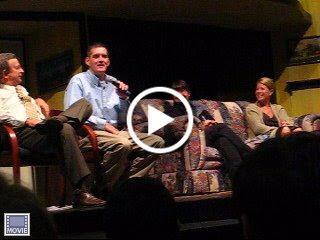
Click on the image to watch a video of the presentation by Sean McGlynn
Our task for the day was to plant native species around California Department of Food and Agriculture building as a sort of demonstration garden and a form of "edible landscaping." The gardens are intended to be educational; they show the public various types of plants indigenous to the area and how to grow them. It also helps raise awareness among city-dwellers about the delicate balance required to successfully cultivate crops, even in a beautiful climate like California's. On that particular day, we planted strawberries, various herbs, and a Native American garden that contained flora handy for cooking, basket weaving, medicine, and other practical uses. We also dug trenches around the perimeter of the beds so the irrigation wouldn't run out into the sidewalk It was long, dirty labor, but it was nice being in the shade, and we actually got a whole lot more work done than our sponsor expected.


Afterward, our host was nice enough to take us across the street to the California State Capitol for an impromptu guided tour. I'd been before to walk the grounds, but this time we actually got to go inside. It was near closing time, so we were forced to run through the huge building in about 10 minutes, but we did get to see Arnold's (a.k.a. "the Governator's") office! I still don't know if it's as nice as the Texas Capitol, but I do definitely have a new respect for the beauty in the details, which consist of a lot of intricate hand-carved and hand-tiled corridors and a lovely marbled rotunda.


I'm a little behind in my posting, so this was actually the last service project I had with my beloved Pod 22. As I mentioned in previous postings, I am now part of Silver 3, so hopefully I'll have time in the upcoming weeks to post about the adventures on my new team.
Fortunately, the panel of speakers was absolutely phenomenal. We had a brief visit from Sacramento Mayor Kevin Johnson (who also happens to be a former Phoenix Suns point guard) who has been doing a lot to promote service in the city by setting a goal of 500,000 hours of community service by the end of 2009.
Karen Baker, the California Secretary of Service and Volunteering (the first state Cabinet position of its kind in the country), gave a particularly inspiring speech. She was witty and engaging and personal and made us really proud to have committed a year of our lives to national service. She reminded us that our enthusiasm and optimism not only gets things done but also encourages the people we consider our role models who work in public service and the non-profit sector.
We also heard from the St. John's Shelter Executive Director Michelle Steeb, who runs a non-profit serving homeless women and their children; Loaves and Fishes Executive Director Libby Fernandez, who works to feed the house the homeless; and Turning Point Executive Director John Buck, a former drug addict who now provides mental health community programs. Each spoke about the challenges facing their respective programs, especially in the midst of the poor economic climate, and the importance of volunteers like us.
For our actual service, my pod went to the California Department of Food and Agriculture, where we were met by Secretary of Agriculture A. G. Kawamura. Despite his impressive Cabinet title, he was an unpretentious and friendly host in his tropical print shirt, blue baseball cap, jeans, and work boots. As a true farmer, his only flaw was perhaps being too interested in his work as he gave us a long-winded but very informative and engaging spiel on the challenges facing agriculture in California, one of the most fertile and productive regions in the nation.

Our task for the day was to plant native species around California Department of Food and Agriculture building as a sort of demonstration garden and a form of "edible landscaping." The gardens are intended to be educational; they show the public various types of plants indigenous to the area and how to grow them. It also helps raise awareness among city-dwellers about the delicate balance required to successfully cultivate crops, even in a beautiful climate like California's. On that particular day, we planted strawberries, various herbs, and a Native American garden that contained flora handy for cooking, basket weaving, medicine, and other practical uses. We also dug trenches around the perimeter of the beds so the irrigation wouldn't run out into the sidewalk It was long, dirty labor, but it was nice being in the shade, and we actually got a whole lot more work done than our sponsor expected.
Afterward, our host was nice enough to take us across the street to the California State Capitol for an impromptu guided tour. I'd been before to walk the grounds, but this time we actually got to go inside. It was near closing time, so we were forced to run through the huge building in about 10 minutes, but we did get to see Arnold's (a.k.a. "the Governator's") office! I still don't know if it's as nice as the Texas Capitol, but I do definitely have a new respect for the beauty in the details, which consist of a lot of intricate hand-carved and hand-tiled corridors and a lovely marbled rotunda.
I'm a little behind in my posting, so this was actually the last service project I had with my beloved Pod 22. As I mentioned in previous postings, I am now part of Silver 3, so hopefully I'll have time in the upcoming weeks to post about the adventures on my new team.
Monday, October 19, 2009
The first week of a new life
The week I've been here has felt like a lifetime, but definitely in a good way. After a year of being relatively unproductive, it has been incredibly gratifying to wake up each morning with a full day of activity and end each day exhausted.
I arrived in Sacramento last Wednesday bright and early in the morning (a special thanks to Vincent for driving me to the airport at 4 a.m.!). It was a long and exhausting flight, but there were thankfully no delays or complications, a huge blessing compared to some travel horror stories I heard later that evening. Upon landing, a big 15-passenger van was waiting to take us to campus. My fellow Americorps members were friendly enough, but the ride was quiet since everyone was still tired from their respective journeys. It gave us some time to absorb our new surroundings and reflect on the mega life changes yet to come.
My first impressions of Sacramento were depressing; the weather was gray and drizzly, and the flat landscape consisted of varying shades of lifeless brown. Our campus certainly isn't very beautiful either. It is made up of four boxy, beige buildings on property that used to be an old U.S. Air Force base, which means lots of concrete and chain link fence.
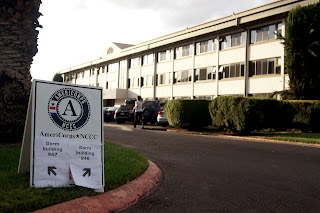
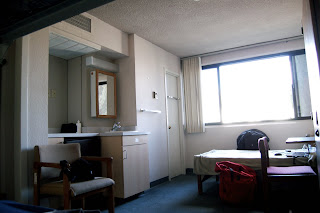
We spent much of the day in in-processing, which meant tons of paperwork and orientations. We also got our spiffy uniforms (worn during all working hours, shirt always tucked in) and dormitory assignments. It feels very much like college life again. I got stuck in a three-person room, so it's a little bit crowded, but my roommates are amiable enough. I put some pictures of my new home below. I'm in the bottom bunk.

I also got to meet the rest of Pod 22, which is hands down the coolest group of people on this campus. Our little family has bonded really quickly; it feels like we've known each other for years. We've got pod members representing from Virginia, Minnesota, South Carolina, Tennessee, Michigan, Vermont, Illinois, Florida, and a whole bunch of other states. Our team leader is Tonye (front row, far left, in the green shirt) , a real easy-going guy who has been a huge help in getting us situated in our new stations.
 To be honest, most of this week has been meeting after interminable meeting. On the worst days, we spend eight hours in front of PowerPoint with just a few short breaks and a lunch hour. These trainings are dull but necessary; they cover safety, policies, insurance, and other pertinent information. Some, like today's training in first aid, were downright fun at times, since we got to role-play using the CPR dummy and the defibrillator. Upon completion, we took an exam and were certified by the American Red Cross. We also underwent physicals, which also included a challenging audio examination, a TB test, and a tetanus vaccination. My arm is still a little sore from that latter shot despite vigorous massage.
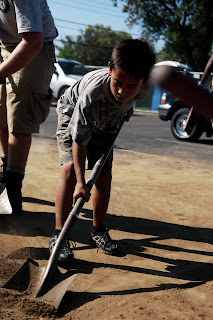
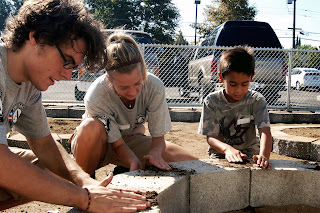
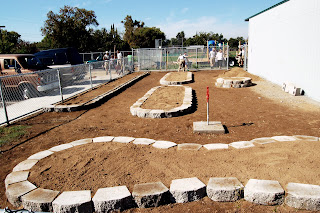
The real exciting stuff came on Saturday though, when we had our first actual service projects in the city. Our first task was at Althea B. Smythe Academy of Arts and Sciences, where we were charged with building a community garden. Although it is a charter school, it is by no means a wealthy campus. The surrounding neighborhood is 70 percent Hispanic, and 90 percent of the students are on the reduced-lunch program, a major indication of poverty in the area. The project we worked on was two years in the making due to major obstacles in grant funding, but it will be a great boon to the school as a place of peace and relaxation as well as science education. In a matter of hours, lined up cinder blocks to create flower beds, broke up the clay-like ground, hauled wheelbarrows full of top soil, and filled up the new beds with rich, brown dirt.
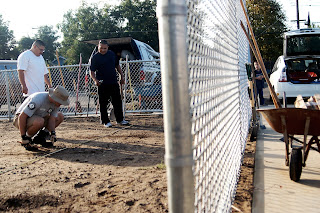
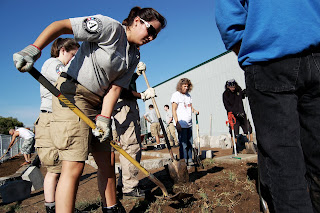

 The really cool part was having the community come out and chip in. It was inspiring to see so many parents involved in their children's schooling, and a lot of the fathers, who were conveniently also professional landscapers, contributed a whole lot more than any of us corps members! One dad we met named Larry was particularly active. In addition to pitching in for the garden, he also designed a beautiful shaded patio that included murals on the walls and benches where students could eat their lunch, read a library book, or safely wait for a ride home away from the busy streetside curb. Not only did he come up with the idea, but he and his daughter installed the decorative brick pavers themselves! The kids were adorable too, with their itty bitty shovels scooping up spoonfuls of soil into the wheelbarrow. Despite their meager efforts, you could tell they were so proud to be a part of creating the garden and were having loads of fun playing in the dirt!

And here it is, the finished product. I forgot to take a "before" picture, but it used to be just an empty brown field of dirt. Now imagine these beds filled with green foliage and beautiful flowers planted by bright, eager elementary school students. Beautiful, no?
After lunch, we headed to an apple orchard, where Americorps teams picked two tons of apples that went straight to the Sacramento Food Bank. As an added bonus, we also got to pick some incredibly fresh plum and pears for ourselves that now sit in a plastic bag in our kitchen.

 This was definitely more of the Sacramento I was envisioning. The orchard was beautiful, awash in golds and greens as far as the eye could see under a cloudless blue California sky. The ground was littered with fallen apples, so there was a sweetly decadent scent of overripe fruit that permeated the grounds. This is something I probably would have paid to do just for pure entertainment but was enjoying it even more knowing that it was all going to a great cause. After picking the low-hanging fruit, we started climbing into the branches or using ladders to reach the higher extremities. We also had some help from these nifty apple-picking tools that consisted of a rake and a basket on an extending pole. It took quite a bit of practice and coordination to get the use of those things down, but we eventually got the hang of it.
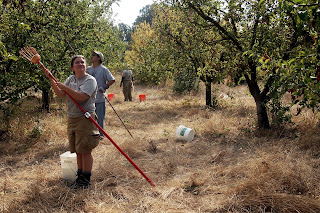


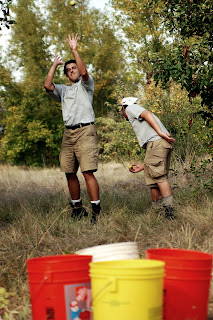
 After a few hours of picking, we sorted through the apples and chunked the bruised, holey, or unripe fruit on the ground. We wound up skating on an entire walkway of apples and had quite a bit of fun with apple-throwing contests.
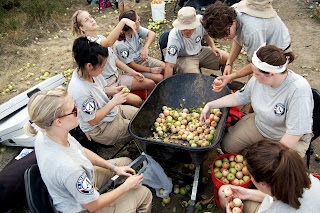
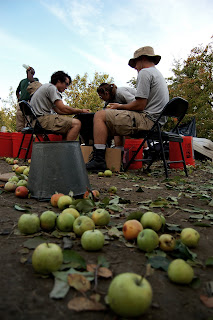
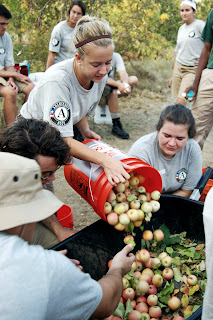
 It's getting late, so I'll have to continue this post another time. (Yes, I now consider 10 p.m. "late," but you would too if you had to get up at 5 a.m. for PT, or physical training!) So far, you've only heard about my week until Saturday, so stay tuned for much, much more to come! Next time, I'll give you some details on my weekend leisure trip to downtown Sacramento, fill you in on the nightmare that is physical training, and let you know about the food situation. I'm sure I've left plenty out, so if you have a question about my life here in Americorps, feel free to leave it in the comments, and I'll try to address it in my next post.
I arrived in Sacramento last Wednesday bright and early in the morning (a special thanks to Vincent for driving me to the airport at 4 a.m.!). It was a long and exhausting flight, but there were thankfully no delays or complications, a huge blessing compared to some travel horror stories I heard later that evening. Upon landing, a big 15-passenger van was waiting to take us to campus. My fellow Americorps members were friendly enough, but the ride was quiet since everyone was still tired from their respective journeys. It gave us some time to absorb our new surroundings and reflect on the mega life changes yet to come.
My first impressions of Sacramento were depressing; the weather was gray and drizzly, and the flat landscape consisted of varying shades of lifeless brown. Our campus certainly isn't very beautiful either. It is made up of four boxy, beige buildings on property that used to be an old U.S. Air Force base, which means lots of concrete and chain link fence.

We spent much of the day in in-processing, which meant tons of paperwork and orientations. We also got our spiffy uniforms (worn during all working hours, shirt always tucked in) and dormitory assignments. It feels very much like college life again. I got stuck in a three-person room, so it's a little bit crowded, but my roommates are amiable enough. I put some pictures of my new home below. I'm in the bottom bunk.


I also got to meet the rest of Pod 22, which is hands down the coolest group of people on this campus. Our little family has bonded really quickly; it feels like we've known each other for years. We've got pod members representing from Virginia, Minnesota, South Carolina, Tennessee, Michigan, Vermont, Illinois, Florida, and a whole bunch of other states. Our team leader is Tonye (front row, far left, in the green shirt) , a real easy-going guy who has been a huge help in getting us situated in our new stations.
 To be honest, most of this week has been meeting after interminable meeting. On the worst days, we spend eight hours in front of PowerPoint with just a few short breaks and a lunch hour. These trainings are dull but necessary; they cover safety, policies, insurance, and other pertinent information. Some, like today's training in first aid, were downright fun at times, since we got to role-play using the CPR dummy and the defibrillator. Upon completion, we took an exam and were certified by the American Red Cross. We also underwent physicals, which also included a challenging audio examination, a TB test, and a tetanus vaccination. My arm is still a little sore from that latter shot despite vigorous massage.
The real exciting stuff came on Saturday though, when we had our first actual service projects in the city. Our first task was at Althea B. Smythe Academy of Arts and Sciences, where we were charged with building a community garden. Although it is a charter school, it is by no means a wealthy campus. The surrounding neighborhood is 70 percent Hispanic, and 90 percent of the students are on the reduced-lunch program, a major indication of poverty in the area. The project we worked on was two years in the making due to major obstacles in grant funding, but it will be a great boon to the school as a place of peace and relaxation as well as science education. In a matter of hours, lined up cinder blocks to create flower beds, broke up the clay-like ground, hauled wheelbarrows full of top soil, and filled up the new beds with rich, brown dirt.


 The really cool part was having the community come out and chip in. It was inspiring to see so many parents involved in their children's schooling, and a lot of the fathers, who were conveniently also professional landscapers, contributed a whole lot more than any of us corps members! One dad we met named Larry was particularly active. In addition to pitching in for the garden, he also designed a beautiful shaded patio that included murals on the walls and benches where students could eat their lunch, read a library book, or safely wait for a ride home away from the busy streetside curb. Not only did he come up with the idea, but he and his daughter installed the decorative brick pavers themselves! The kids were adorable too, with their itty bitty shovels scooping up spoonfuls of soil into the wheelbarrow. Despite their meager efforts, you could tell they were so proud to be a part of creating the garden and were having loads of fun playing in the dirt!


And here it is, the finished product. I forgot to take a "before" picture, but it used to be just an empty brown field of dirt. Now imagine these beds filled with green foliage and beautiful flowers planted by bright, eager elementary school students. Beautiful, no?

After lunch, we headed to an apple orchard, where Americorps teams picked two tons of apples that went straight to the Sacramento Food Bank. As an added bonus, we also got to pick some incredibly fresh plum and pears for ourselves that now sit in a plastic bag in our kitchen.

 This was definitely more of the Sacramento I was envisioning. The orchard was beautiful, awash in golds and greens as far as the eye could see under a cloudless blue California sky. The ground was littered with fallen apples, so there was a sweetly decadent scent of overripe fruit that permeated the grounds. This is something I probably would have paid to do just for pure entertainment but was enjoying it even more knowing that it was all going to a great cause. After picking the low-hanging fruit, we started climbing into the branches or using ladders to reach the higher extremities. We also had some help from these nifty apple-picking tools that consisted of a rake and a basket on an extending pole. It took quite a bit of practice and coordination to get the use of those things down, but we eventually got the hang of it.


 After a few hours of picking, we sorted through the apples and chunked the bruised, holey, or unripe fruit on the ground. We wound up skating on an entire walkway of apples and had quite a bit of fun with apple-throwing contests.


 It's getting late, so I'll have to continue this post another time. (Yes, I now consider 10 p.m. "late," but you would too if you had to get up at 5 a.m. for PT, or physical training!) So far, you've only heard about my week until Saturday, so stay tuned for much, much more to come! Next time, I'll give you some details on my weekend leisure trip to downtown Sacramento, fill you in on the nightmare that is physical training, and let you know about the food situation. I'm sure I've left plenty out, so if you have a question about my life here in Americorps, feel free to leave it in the comments, and I'll try to address it in my next post.
Subscribe to:
Posts (Atom)